
Why Immersive Experiences Matter: The Human Psychology Behind Interactive Public Art
An exploration of the human psychology behind immersive, interactive public art, why trust, emotional safety and intuitive participation matter more than technology. Drawing on real-world public installations, this essay looks at how thoughtfully designed immersive experiences invite empathy, play and shared authorship in civic space.
IMMERSIVE ART & EXPERIENCE DESIGNPUBLIC SPACE & PLACEMAKINGCREATIVE TECHNOLOGY
Why Immersive Experiences Matter: The Human Psychology Behind Interactive Public Art
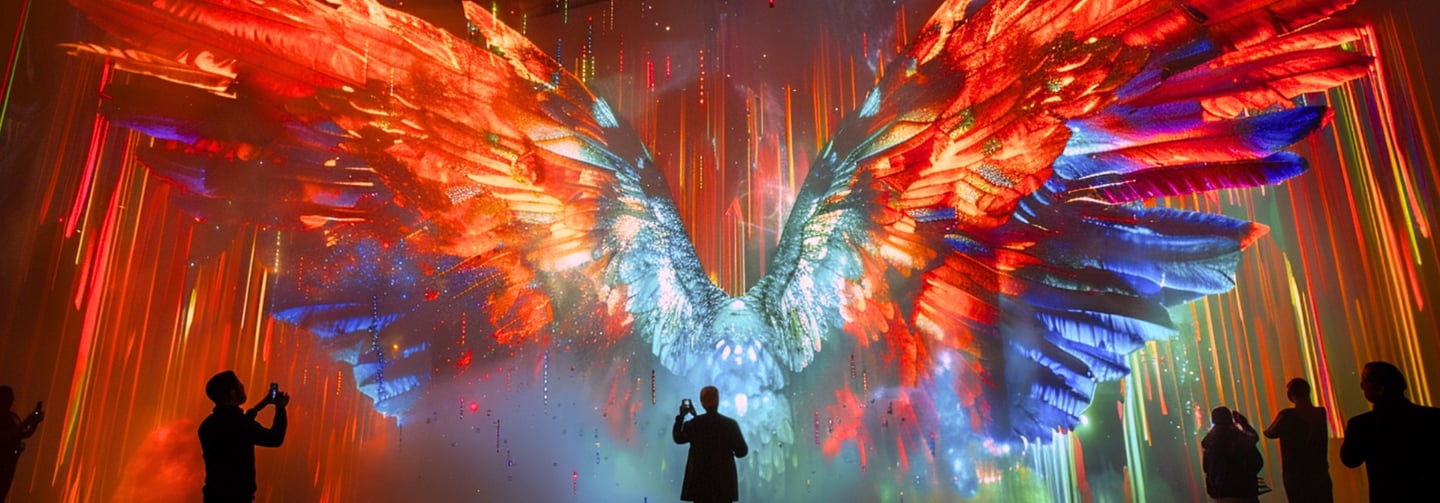
There’s a moment I always watch for in public space.
Someone slows down.
They hover at the edge of an artwork.
They look around , not at the work, but at other people.
It’s a small, human pause. And it tells me everything.
Because immersive experiences don’t fail or succeed based on technology.
They succeed or fail based on whether people feel safe enough to step inside.
We Don’t Enter Experiences , We Test Them
In psychology, we know that humans are constantly scanning for cues:
Is this place for me?
Will I look foolish?
Am I allowed to participate , or am I about to be watched?
Public space amplifies these questions. Unlike galleries or theatres, there’s no agreed social contract. People arrive as themselves , tired, curious, guarded, open, shy, bold , often all at once.
So when we talk about immersive public art, the real design challenge isn’t scale or spectacle.
It’s trust.
This is something researchers like Brené Brown have articulated beautifully: vulnerability only emerges when people feel psychologically safe. The same principle applies in spatial design. If an experience demands performance before permission, most people opt out.
What I’ve learned through years of building interactive works is simple:
Participation is not an instruction.
It’s an invitation.
Immersion Isn’t About More , It’s About Alignment
There’s a misconception that immersive experiences are about adding layers:
more screens
more sensors
more interactivity
more “wow”
But the most effective immersive works I’ve seen , and built , often do less.
They align:
• movement with meaning
• feedback with feeling
• response with respect
When an environment responds gently to presence , a shift in light, a soft change in sound, a visual echo , people instinctively understand the rules of the space. No tutorial needed.
This is where psychology meets design.
Our nervous systems are incredibly good at reading environments. We feel rhythm before we understand language. We sense intention before we decode mechanics. When immersive systems are tuned to these instincts, people relax. Curiosity replaces self-consciousness. Play emerges.
That’s not accidental. It’s authored.
The Audience Isn’t the User , They’re the Author
One of the most powerful shifts in immersive practice is moving away from “user experience” toward authorship.
When people realise that their presence changes a space , that they are not consuming content but shaping it , something subtle happens. Identity softens. Strangers collaborate without speaking. The artwork becomes a commons rather than a performance.
This is why the phrase “the audience becomes the artist” isn’t a metaphor in my work. It’s a structural principle.
People don’t need to be told what to do.
They need to be shown that their input matters.
Public Space Is an Emotional Commons
Cities are not just infrastructure. They are emotional systems.
Public art, when done thoughtfully, acts as a tuning mechanism for those systems. It can slow people down. Invite reflection. Create moments of shared rhythm. It can also do harm if it overwhelms, excludes, or prioritises spectacle over dignity.
This is where ethics come in , not as an afterthought, but as design material.
Consent.
Choice.
Graceful exits.
Multiple ways to participate (or not).
These aren’t soft concerns. They’re what allow immersive experiences to work at scale , across ages, cultures, abilities, and moods.
As futurists like Catherine Ball often remind us, technology shapes behaviour whether we intend it to or not. The question is whether we design systems that dominate attention , or ones that support agency, care, and shared humanity.
Why This Matters Now
We’re living in an era of algorithmic isolation. Personalised feeds. Filtered realities. Experiences designed for us, not with us.
Immersive public experiences offer something quietly radical in contrast:
• shared attention
• moments where difference coexists without debate
They are rehearsals for how we might be together.
When designed with psychological insight and human respect, interactive public art becomes more than entertainment. It becomes a social technology , one that practices empathy through play rather than preaching it.
And perhaps that’s the real power of immersion.
Not that it surrounds us.
But that, for a moment, it reminds us we belong , to ourselves, to each other, and to the space we’re standing in.