
How to Design Interactive Experiences that People Actually Want to Join
Why do people hover at the edge of interactive experiences before they step in? This piece explores how story, emotional legibility and elemental world-building help audiences feel included, so participation becomes instinctive, not intimidating.
IMMERSIVE ART & EXPERIENCE DESIGNINTERACTIVE DESIGNPUBLIC SPACE & PLACEMAKING
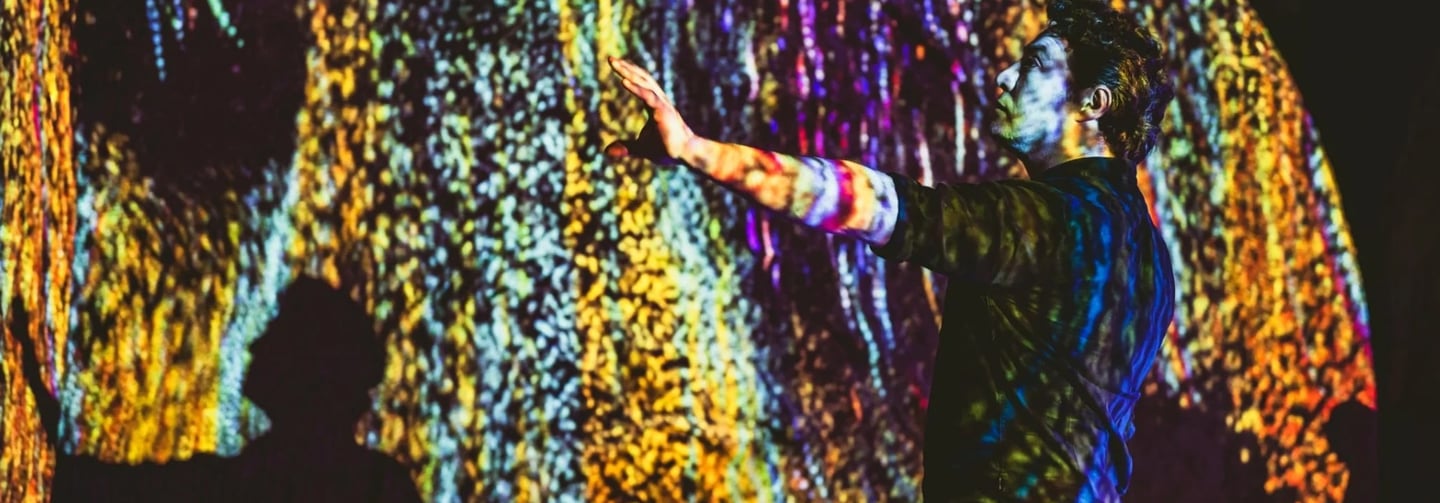
There’s a moment that happens before participation.
Someone slows down.
They hover at the edge of an experience.
They’re not asking, How does this work?
They’re asking something quieter:
Will this make sense to me?
Will I feel included here?
Because legibility in immersive art isn’t really about instructions.
It’s about story.
Accessibility Is Not About Dumbing Things Down
When people talk about accessibility in interactive design, it often gets reduced to technology:
app-free interaction
intuitive interfaces
clear feedback loops
Those things matter. But they’re only half the equation.
An experience can be technically legible and still emotionally opaque.
True accessibility means people understand , instinctively , what kind of world they’ve stepped into, and what it’s inviting them to feel.
That’s not a UX problem.
That’s a storytelling one.
Why Story Comes Before Interaction
Before anyone moves, touches, or plays, they are orienting themselves inside a narrative , even if they don’t consciously name it.
Is this playful or reverent?
Is it social or solitary?
Is it fast or slow?
Is it asking me to perform, or simply to arrive?
When the narrative layer is unclear, people hesitate. When it’s overly specific, people self-exclude.
But when the story is elemental, something different happens.
People recognise it in their bodies before they understand it in their heads.
Elemental Stories Speak Across Difference
This is why I return, again and again, to mythological and elemental frameworks in immersive work.
Not because they’re decorative , but because they’re universally relatable
Water , nature
Breath.
Light.
Stars, Shadow.
Transformation.
Thresholds.
Ritual.
These aren’t cultural clichés. They’re human constants.
Elemental storytelling doesn’t ask people to decode references or read instructions. It invites them into sensations they already know , flowing, gathering, dissolving, emerging.
A child doesn’t need context to understand a ripple.
An elder doesn’t need translation to feel the weight of light or sound.
Different cultures may interpret the meaning differently , and that’s the point.
The story is open enough to hold many readings at once.
Emotion Is the Entry Point to Participation
People don’t join interactive experiences because they understand them intellectually.
They join because something resonates.
A tone.
A rhythm.
A feeling of safety.
A flicker of curiosity.
This is where immersive art overlaps with what researchers like Brené Brown describe so clearly: empathy isn’t something you explain people into. It’s something you activate by creating the right conditions.
Narrative does that work quietly.
When an experience carries a coherent emotional arc , even a loose one , people sense where they are inside it. They know whether to approach gently, play boldly, linger, or step back.
That clarity reduces self-consciousness.
And reduced self-consciousness is what makes play possible.
Designing Worlds, Not Just Systems
One of the biggest shifts in my practice was moving from designing interactions to designing worlds.
A system can be impressive.
A world can be entered.
World-building doesn’t require complexity. It requires consistency.
When visuals, sound, pacing, and response all speak the same emotional language, people don’t need explanation. They intuit the rules.
This is why mythic storytelling works so well in public space. It doesn’t demand attention , it holds it.
It gives people permission to bring their own meaning without fear of being “wrong.”
Technology as the Translator, Not the Hero
In this framework, technology isn’t the headline.
It’s the translator.
Real-time systems allow the environment to respond like a living thing , to presence, proximity, movement, sound. But the reason those responses matter is because they reinforce the story being told.
As futurist Catherine Ball often points out, technology shapes behaviour whether we intend it to or not. When it’s aligned to a clear narrative and ethical intent, it becomes a bridge rather than a barrier.
People don’t feel like they’re “using tech.”
They feel like they’re inside something.
When It Works, People Don’t Ask What It Is
One of my favourite signals that an experience is working is when people stop trying to name it.
They don’t ask if it’s an artwork, a game, or an installation.
They don’t look for instructions.
They don’t worry about getting it “right.”
They respond.
They move.
They wait.
They mirror.
They invite others in.
The narrative has done its job.
Designing for Many Ways In
Elemental, myth-based storytelling creates multiple entry points at once.
Some people engage physically.
Some emotionally.
Some observationally.
No single behaviour is privileged. No single reading is required.
That’s what makes these experiences accessible across ages, cultures, and confidence levels , without flattening the work or over-explaining it.
The artwork doesn’t demand understanding.
It earns trust.
And trust is what turns public space into a place people actually want to be.