
Beyond Spectacle: Can Immersive Technology Make Us More Human?
A reflection on how immersive technology can expand empathy, identity play and creative expression — not as spectacle, but as a design intention. This essay explores how XR and interactive systems can help strangers connect, practice perspective shift, and create more human public experiences.
IMMERSIVE ART & EXPERIENCE DESIGNINTERACTIVE DESIGNTHOUGHTS/ESSAYS
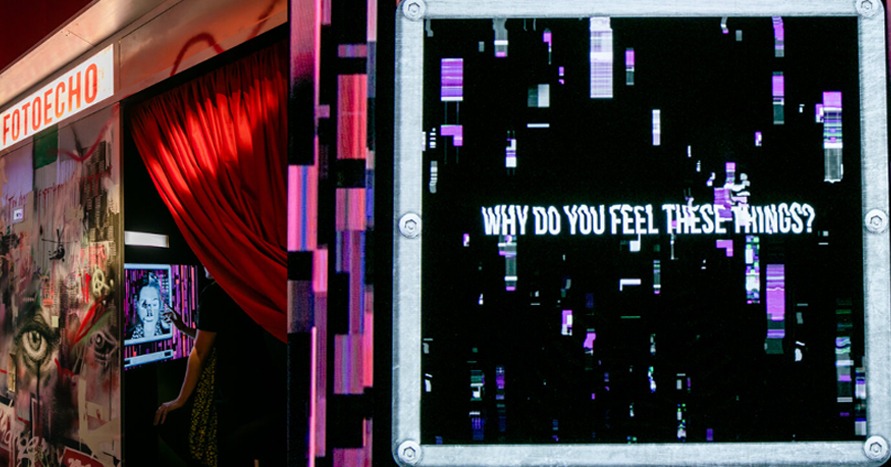
This is the question that keeps tugging at me...
Not as a fear and not as blind optimism either..
More like a practical design challenge I keep returning to.
Technology already teaches us things. It teaches us where to place our attention, how quickly to react, what to value, what to ignore. Sometimes it narrows us. Sometimes it softens us. The part we forget is that none of this is neutral. These systems carry values, whether we admit it or not.
So the real question becomes: can we build technology that expands our humanity instead of shrinking it?
I think we can.
And not in vague ways. In very specific, very human ways.
1. Stepping Into Another Perspective
There is something quietly radical about perspective shift.
With XR systems, virtual reality, augmented reality, mixed reality, you can step into another environment, another body, another lived experience. Not as a tourist. Not as a spectacle. As practice.
When it is done with care, this is not escapism. It is empathy training.
Because it interrupts the feeling that our own perspective is complete. It loosens certainty. It introduces dimensions we did not know we were missing. It gets us out of our siloed viewpoint, and it does it without debate. You do not get argued into empathy. You experience your way into it.
Even a brief moment of seeing through someone else’s eyes can change the shape of what you assume.
2. Identity Play Through Avatars
Avatars are often framed as masks. I think they can be mirrors.
They give people permission to explore. Not to hide, but to try on different ways of being. Confidence. softness. power. ambiguity. joy. vulnerability. All the versions of the self that do not always feel safe in public.
For young people especially, and for anyone who has never felt fully reflected in dominant narratives, this kind of identity play can be deeply stabilising. It can be a rehearsal space where self worth is allowed to grow.
And the more we experience ourselves as changeable, the more tolerant we become of change in others.
3. New Tools for Creative Expression
A lot of people carry a quiet belief that they are not creative.
Immersive and generative tools can gently dismantle that belief.
When someone realises they can animate a character with their body, shape visuals with sound, create movement driven worlds, without years of technical training, something opens.
Creativity stops being a rare talent and becomes a language.
These tools do not replace craft. They widen the doorway. They let people who never saw themselves as artists feel authorship for the first time. And that matters, because creative expression is not just cultural output. It is emotional processing. It is nervous system regulation. It is identity formation. It is how people translate what they feel into something shareable.
Giving people access to expression is not fluff. It is care.
4. New Ways to Communicate and Translate
Technology can also give us new ways to communicate beyond words.
Movement. rhythm. sound. presence. visual response.
In many immersive environments, people coordinate without sharing a spoken language. They understand each other through timing and gesture and the way the space responds back. That is a kind of communication that crosses age, culture, literacy, and confidence.
It also opens new forms of translation. Not just translating language, but translating inner states. Translating feeling into form. Translating experience into something others can sense.
This is the kind of future I care about. Not faster systems, but better translation. More people able to be understood.
5. Breaking Down Distance Between Strangers
One of the most profound things I have witnessed through my work is how quickly intimacy can form when the conditions are right.
In ECHO, people encounter the stories of strangers. Not as content. As shared humanity.
Faces morph. boundaries soften. You recognise yourself in someone you have never met. And the intimacy is surprising. It arrives quickly. It is not forced.
When an experience allows you to feel the truth of another person, emotional intelligence grows fast. Not because you are told what to think. Because you feel something real, in your body, before you can explain it.
This is one of the great ironies. Technology is often blamed for disconnection. And yet, when designed with care, it can be the thing that helps strangers cross the distance between them.
What All of This Has in Common is that none of these outcomes happen automatically.
Technology does not make us better humans by default.
But when we design for perspective shift, identity exploration, creative expression, new forms of communication, and meaningful proximity between strangers, something changes.
The tools become developmental, not just entertaining.
They help us practise being more open. More curious. More connected. Less certain. More awake to each other.
The Question We Need to Ask
Maybe the question is not can technology teach us to be better humans.
Maybe the question is whether we are willing to design it that way.
The tools already exist. What is rare is intention.
To build systems that do not just capture attention, but cultivate empathy. To create experiences that do not flatten difference, but hold it.
To use technology not as an escape from humanity, but as a mirror that helps us see each other more clearly.
That is the future I want to build.